


Choosing a nicotine pouch strength ought to be simple. There’s a number on the can, so you pick the number that sounds right and get on with your day.
Unfortunately, nicotine pouches didn’t get that memo.
The amount of nicotine in a pouch is obviously important, but it isn’t the only thing that determines how strong the pouch feels. The pouch’s size, moisture level, pH, filler material and flavor ingredients can all change the speed and intensity of the experience. Two products containing exactly the same amount of nicotine can feel surprisingly different.
In this guide, I’ll explain how nicotine pouch strengths are measured, what the different strength levels mean and how to choose an appropriate starting point. I’ll also explain why a small 6 mg pouch can sometimes feel stronger than a larger one, why mint flavors can exaggerate the apparent strength and why the number printed on the can doesn’t necessarily tell you how much nicotine your body will actually absorb.
Nicotine Pouch Strengths at a Glance

| Strength | Typical Nicotine Content | Who It May Suit |
|---|---|---|
| Low | 2–3 mg per pouch | Current vapers, light nicotine users and people trying pouches for the first time |
| Regular | 4–6 mg per pouch | Current smokers, established vapers and people who found lower strengths unsatisfying |
| Strong | 7–9 mg per pouch | Experienced nicotine pouch users and some former heavy smokers |
| Extra Strong | 10–15 mg per pouch | Experienced oral nicotine or smokeless tobacco users |
| Extreme | More than 15 mg per pouch | Very experienced users only; generally unnecessary for most people |
These categories are only rough guidelines. There is no universal rule stating that 6 mg must be called “regular” or that 9 mg must be called “strong.” One brand’s regular pouch can contain as much nicotine as another brand’s extra-strong pouch.
The actual milligram amount is always more useful than marketing terms, colored circles, lightning bolts or intimidating names involving words like “ultra,” “max” and “nuclear.”
What Does Nicotine Pouch Strength Mean?
Nicotine pouch strength usually refers to the amount of nicotine contained in each individual pouch. In the United States, this is normally printed as milligrams per pouch, often abbreviated as mg/pouch.
A 3 mg pouch contains approximately 3 milligrams of nicotine. A 6 mg pouch contains approximately 6 milligrams, and a 9 mg pouch contains 50 percent more nicotine than a 6 mg pouch.
That sounds straightforward, but there are two important details to remember.
First, the listed amount describes how much nicotine is in the pouch. It does not mean that your body will absorb every milligram. Some nicotine will remain in the pouch when you discard it, and the amount absorbed can vary depending on the formulation, how long you use the pouch and your individual saliva production.
Second, nicotine content and nicotine delivery are not quite the same thing. A pouch can contain a relatively modest amount of nicotine but release it quickly. Another can contain more nicotine but deliver it gradually over a longer period. The first pouch may feel more intense even though the second contains more nicotine overall.
What Nicotine Pouch Strengths Are Available?
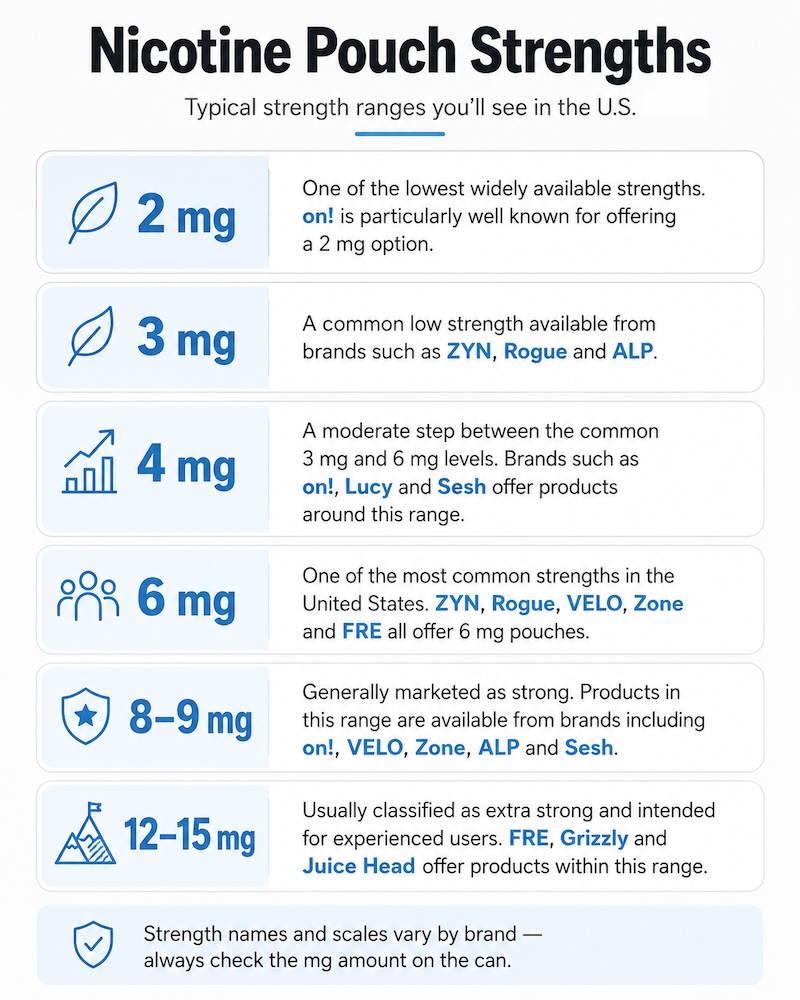 The mainstream U.S. nicotine pouch market begins at around 2 mg per pouch and extends to approximately 15 mg per pouch. Some imported brands go much higher, but strengths above 15 mg are unnecessary for most nicotine users and are particularly unsuitable for beginners.
Here are some examples of the strength ranges you may encounter.
- 2 mg: One of the lowest widely available strengths. The on! brand is particularly well known for offering a 2 mg option.
- 3 mg: A common low strength available from brands such as ZYN, Rogue and ALP.
- 4 mg: A moderate step between the common 3 mg and 6 mg levels. Brands such as on!, Lucy and Sesh offer products around this range.
- 6 mg: One of the most common strengths in the United States. ZYN, Rogue, VELO, Zone, FRE and many other brands offer 6 mg pouches.
- 8–9 mg: Generally marketed as strong. Products in this range are available from brands including on!, VELO, Zone, ALP and Sesh.
- 12–15 mg: Usually classified as extra strong and intended for experienced users. FRE, Grizzly, Juice Head and several other brands offer products within this range.
Availability changes frequently, so check the number printed on the individual can rather than assuming that every product from a brand comes in the same strengths.
Milligrams per Pouch vs. Milligrams per Gram
Most nicotine pouches sold in the United States list their strength in milligrams per pouch. This is the easiest format to understand because it tells you how much nicotine is contained in the portion you’re actually going to use.
However, some products—particularly those made for European markets—list nicotine concentration in milligrams per gram, abbreviated as mg/g.
Milligrams per gram tells you the concentration of nicotine in the pouch material. It does not tell you the amount in one pouch unless you also know how much each pouch weighs.
How to Convert mg/g to mg per Pouch
Use this formula:
Nicotine in mg per pouch = nicotine in mg/g × pouch weight in grams
Suppose a product is labeled as containing 12 mg/g of nicotine, and each pouch weighs 0.5 gram:
12 mg/g × 0.5 g = 6 mg per pouch
If the individual pouch weight isn’t printed on the can, you can often calculate it using the total net weight and the number of pouches.
For example, a can containing 20 pouches with a total net weight of 10 grams has an average pouch weight of 0.5 gram:
10 grams ÷ 20 pouches = 0.5 gram per pouch
You can then multiply that number by the listed mg/g concentration.
This calculation matters because two pouches with the same mg/g rating can contain different total amounts of nicotine if one pouch is larger than the other.
Don’t Rely on Dots, Bars or Strength Names
Some nicotine pouch cans use dots, bars, circles or similar graphics to indicate strength. You may also see descriptions such as:
- Normal
- Regular
- Strong
- Extra strong
- Ultra strong
These systems are not standardized. Three dots from one brand may represent 6 mg per pouch, while three dots from another could represent 12 mg or more.
Use the graphics as a quick reference within a single brand, but don’t use them to compare different brands. Look for the actual nicotine content in mg per pouch—or calculate it from mg/g—before buying.
What Strength Should You Choose for Your First Nicotine Pouch?
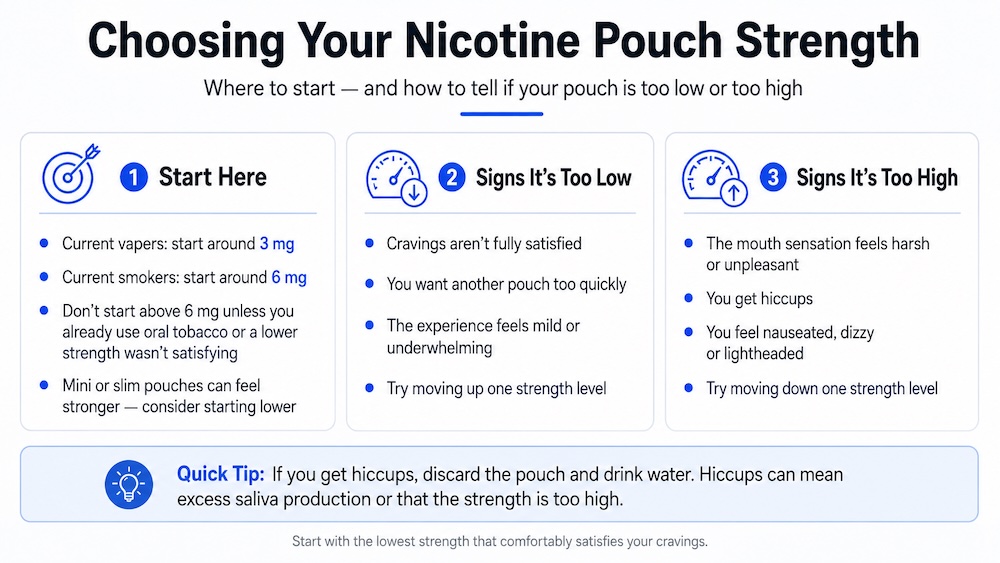
My usual starting recommendation is fairly simple:
- Current vapers: Start at around 3 mg per pouch.
- Current smokers: Start at around 6 mg per pouch.
I generally don’t suggest starting above 6 mg unless you already have substantial experience with oral tobacco products such as snus or smokeless tobacco. It can also make sense to try a stronger pouch if you’ve already used a lower strength and genuinely didn’t find it satisfying.
The goal isn’t to choose the highest number you think you can survive. The goal is to find the lowest strength that comfortably satisfies your cravings.
Starting Strength for Current Vapers
Around 3 mg is a sensible starting point for many current vapers. Vaping delivers nicotine through the lungs, so the onset is much quicker than it is with an oral pouch. Even if you use a fairly strong e-liquid, that doesn’t necessarily mean you need a high-strength pouch.
You also can’t directly convert an e-liquid strength such as 20 mg/ml or 50 mg/ml into an equivalent pouch strength. The number on an e-liquid bottle describes concentration in the liquid, not the amount absorbed during each puff or vaping session.
Some heavy vapers may eventually prefer 4–6 mg pouches, but starting at 3 mg gives you room to evaluate the product without immediately launching your hiccups into low Earth orbit.
Starting Strength for Current Smokers
For a current smoker, I typically suggest starting at around 6 mg per pouch. Cigarettes deliver nicotine rapidly, and many smokers find that a 2–3 mg pouch doesn’t provide enough satisfaction when they’re first switching to oral nicotine.
Cigarette consumption is an imperfect guide, though. Someone who smokes five cigarettes per day may need less nicotine than someone who smokes two packs, but inhaling style, cigarette type and individual dependence also matter.
A lighter smoker may be perfectly satisfied with 3–4 mg. A heavy smoker can still begin with 6 mg and move up later if necessary.
Starting Strength for Smokeless Tobacco or Snus Users
Experienced users of snus, dip or chewing tobacco may have a greater tolerance for oral nicotine and may find 3–6 mg pouches too mild. Even so, switching directly to the strongest product available isn’t always wise because modern nicotine pouch formulations can deliver nicotine very differently from traditional tobacco products.
Start with a moderate strength unless you already know how you respond to the specific product.
Why Two Pouches with the Same Strength Can Feel Completely Different
A milligram number tells you the quantity of nicotine in the pouch. It doesn’t fully describe the experience.
Several variables can affect how quickly the nicotine becomes available and how intense the pouch feels:
- Pouch size and format
- Amount and type of filler material
- Moisture level
- Product pH
- Nicotine formulation
- Flavor ingredients and sensory additives
- Saliva production
- Placement in the mouth
- How long the pouch remains in use
This is why changing brands can sometimes feel like changing strengths even when the number printed on the can stays the same.
How Pouch Format Affects Perceived Strength
Nicotine pouches are available in several formats, including mini, slim, regular and maxi. Smaller pouches are usually more discreet, while larger pouches contain more filler and may provide a longer-lasting flavor and nicotine experience.
You’ll often see claims that larger pouches release nicotine more quickly because they have more surface area touching the inside of the mouth. That sounds plausible, but it doesn’t match my experience particularly well.
When the nicotine content is the same, I often find that a smaller pouch delivers a quicker and sharper experience. My theory is that the smaller pouch contains less filler material, so the same amount of nicotine is concentrated into a smaller mass and becomes available relatively quickly.
A larger pouch has more filler material to hold the nicotine, moisture and flavoring ingredients. In my experience, that tends to spread the delivery over a longer period. The experience feels slower and steadier, and the flavor often lasts longer as well.
This isn’t a universal scientific rule. Pouch formulation varies enormously, and ingredients such as humectants, binders and pH adjusters can easily outweigh the effect of size alone. Still, it’s a useful practical consideration when switching formats within a product range.
If a slim or regular 6 mg pouch feels comfortable but the mini version feels unexpectedly aggressive, dropping to a lower strength may make sense. Conversely, a larger pouch containing the same amount of nicotine may feel gentler but last longer.
How pH Modifiers Affect Nicotine Delivery
Nicotine absorption through the lining of the mouth is strongly influenced by pH.
Nicotine can exist in different chemical forms. When the environment inside the pouch is more alkaline, a greater proportion of the nicotine is present in its unprotonated or “free” form. That form passes through the oral tissue more readily.
Manufacturers can adjust pH using ingredients such as sodium carbonate or sodium bicarbonate. A pouch with a formulation designed to produce a higher proportion of readily absorbable nicotine may feel quicker and stronger than another pouch with the same total nicotine content. This, by the way, is why some pouches taste a little salty.
It’s helpful to separate two related processes:
- Release: Nicotine dissolves and moves out of the pouch material.
- Absorption: The dissolved nicotine passes through the tissue inside your mouth.
A higher pH doesn’t necessarily force nicotine out of the pouch more quickly. Instead, it can make the nicotine that has already been released easier for your body to absorb.
This distinction explains why the milligram amount alone can’t predict the exact intensity of a pouch. Two 6 mg products may release similar amounts of nicotine, but the product with the more absorption-friendly pH may feel noticeably stronger.
How Moisture Affects Nicotine Delivery
Nicotine needs moisture before it can dissolve and begin moving into the tissue inside your mouth.
A moist pouch already contains enough liquid to begin producing flavor and sensation almost immediately. It may feel active as soon as you place it under your lip.
A dry pouch usually needs to absorb some saliva before it really gets going. That can produce a short delay, particularly if you naturally have a dry mouth. Some users moisten a dry pouch briefly with their tongue before placing it under the lip, although this can make the initial release feel more abrupt.
As a general rule, a moist pouch often feels quicker because there’s little or no startup period. A dry pouch may feel gentler at first and build more gradually.
Moisture isn’t a perfect predictor of delivery speed, though. Some moist formulations contain humectants or produce a thicker liquid that slows diffusion. Filler composition, solubility and manufacturing methods also matter. In other words, moisture is one piece of the puzzle—not a horsepower rating printed on the side of the can.
If you’re trying a dry pouch for the first time, give it a few minutes before deciding that the strength is too low. You may simply be experiencing a slower start.
How Flavor and Sensory Ingredients Change Perceived Strength
Flavor doesn’t change the number of milligrams in a pouch, but it can dramatically change how strong the pouch seems.
Mint, Menthol and Cooling Agents
Mint and menthol pouches often produce a cooling or tingling sensation against the gum. That sensation can make the pouch feel stronger even though the nicotine content is identical to a fruit, coffee or unflavored version.
Some products use natural mint compounds. Others include synthetic cooling agents that activate cold-sensitive receptors without contributing a traditional mint flavor.
One example is WS-3, an odorless cooling agent that has been identified in laboratory testing of ZYN Chill. It can create a strong cold sensation without tasting like peppermint or menthol.
That doesn’t mean every product called “Chill” uses WS-3. Ingredient formulas are often proprietary, and similarly named products from different brands shouldn’t be assumed to contain the same additives.
Heating, Buzzing and Tingling Ingredients
Cooling isn’t the only sensation manufacturers can add. Some ingredients produce warmth, irritation, buzzing or numbness.
- Capsaicin is the compound responsible for the heat produced by chili peppers. It is also used in some spicy candies.
- Hydroxy-alpha-sanshool, found in Sichuan pepper, produces a distinctive buzzing, tingling and slightly numbing sensation.
- Synthetic cooling agents can create a sharp tingle that some people interpret as both cold and mildly spicy.
ZONE Chill, for example, produces an unusual flavor-free cooling or tingling sensation that reminds me slightly of the sensory additives used in some spicy candies. I haven’t found reliable public confirmation of the exact ingredient responsible, so I wouldn’t confidently call it capsaicin, sanshool or WS-3.
The important point is that sensory intensity doesn’t necessarily equal nicotine intensity. A pouch that makes your gum feel as though it has joined a polar expedition may not contain any more nicotine than the mild fruit pouch beside it.
How to Tell if Your Nicotine Pouch Strength Is Too Low
The most obvious sign that a pouch is too weak is that it simply doesn’t satisfy you.
Possible signs include:
- Your nicotine craving remains unchanged.
- You feel an immediate urge to use another nicotine product.
- You repeatedly want to replace the pouch after only a few minutes.
- The pouch provides flavor and mouth sensation but no noticeable relief from cravings.
Before increasing the strength, make sure the problem isn’t slow delivery. A dry pouch may need several minutes to become fully active, and a larger pouch may provide a more gradual experience than a mini pouch.
You should also consider whether the product’s flavor or pouch shape is the real issue. An uncomfortable pouch can feel unsatisfying even when it contains enough nicotine.
If you consistently finish the normal usage period and still feel unsatisfied, moving up one strength level may be reasonable. Increase gradually rather than jumping from 3 mg directly to 12 mg.
How to Tell if Your Nicotine Pouch Strength Is Too High
A pouch that is too strong usually announces itself fairly clearly.
Early warning signs can include:
- An unpleasantly intense burning or tingling sensation
- Hiccups
- Nausea
- Dizziness or lightheadedness
- Headache
- Sweating
- Shakiness
- A pounding or unusually fast heartbeat
- A general feeling that you’ve made a poor life choice
A mild tingle is normal with many products, particularly mint and high-pH formulations. Pain, severe irritation or rapidly increasing discomfort shouldn’t be treated as something you need to “push through.”
If the pouch feels too strong, remove it immediately. Drinking water often helps with hiccups and can clear lingering flavor or irritation from the mouth. Don’t replace the pouch with another one, and don’t use a second nicotine product while you’re waiting for the symptoms to pass.
Seek medical advice or contact Poison Control if symptoms are severe, persistent or worsening. Difficulty breathing, confusion, fainting, seizures, repeated vomiting or an abnormal heartbeat require urgent medical attention.
Why Nicotine Pouches Can Cause Hiccups
Hiccups are one of the classic signs that an oral nicotine product is delivering more nicotine—or more irritation—than you’re comfortable with.
They may be triggered when nicotine-containing saliva is swallowed and irritates the throat, esophagus or diaphragm-related nerves. Strong flavoring ingredients can contribute as well.
The easiest response is to remove the pouch and drink some water. The hiccups will usually settle once you stop the additional nicotine and sensory stimulation.
If one particular strength repeatedly causes hiccups, move down rather than trying to build tolerance to an unpleasant experience.
Don’t Confuse “Too Strong” with “Too Minty”
Suppose you use a 6 mg berry pouch comfortably but find a 6 mg peppermint pouch almost unbearable. That doesn’t necessarily mean you can’t tolerate 6 mg of nicotine.
The peppermint pouch may contain menthol, cooling agents or other sensory ingredients that amplify the gum sensation. Trying a non-mint flavor at the same strength can help you determine whether the problem is nicotine or flavor.
The reverse can happen as well. A sweet fruit pouch may feel deceptively mild even though it delivers nicotine efficiently. Don’t assume that a gentle flavor means you can safely use multiple pouches.
Does Using a Pouch Longer Increase the Nicotine Dose?
Generally, the longer you keep a pouch in your mouth, the more opportunity it has to release nicotine. Delivery isn’t perfectly linear, though. Many products release a substantial portion of their available nicotine early and then slow down.
A pouch containing 6 mg doesn’t necessarily release all 6 mg during normal use, and your body won’t necessarily absorb everything that is released.
Using a pouch longer can extend the experience, but it won’t always make a weak product dramatically stronger. Once the release rate has slowed, keeping a flavorless piece of damp fabric under your lip for another hour may achieve little beyond testing your commitment.
Should You Use Two Pouches at Once?
I don’t recommend using two pouches at once when you’re still trying to determine your ideal strength.
Two 3 mg pouches contain the same total amount of nicotine as one 6 mg pouch, but the experience may not be identical. Using two pouches increases the total contact area and places the product in two locations, which can affect delivery and make the result harder to predict.
It’s much easier to evaluate one pouch at a time. If 3 mg is consistently too weak, buy a 4 mg or 6 mg product rather than doubling up.
Should You Use a Lower Strength After Taking a Break?
Yes. Nicotine tolerance can decrease when you stop using nicotine or substantially reduce your intake.
A strength that felt comfortable several weeks or months ago may feel much stronger after a break. Return with a lower-strength pouch and evaluate your response rather than assuming your old tolerance is still present.
The same advice applies after an illness or any other period when you’ve used less nicotine than usual.
Can You Cut a Nicotine Pouch in Half?
Cutting a pouch isn’t a reliable way to reduce the strength.
The filler can spill out, and the nicotine may not be distributed perfectly evenly throughout the material. Cutting the pouch also damages the outer fabric and may expose your gum directly to concentrated filler and flavoring ingredients.
Buy a lower strength instead.
How to Compare Strengths When Switching Brands
When trying a new brand, don’t assume that your usual milligram level will feel exactly the same.
A sensible approach is to:
- Check whether the strength is listed in mg per pouch or mg/g.
- Compare the pouch size and moisture level with your usual product.
- Consider whether the flavor contains mint, menthol or another intense sensory ingredient.
- Use one pouch and remove it early if the experience becomes uncomfortable.
- Avoid combining the new pouch with vaping, smoking or another nicotine product during the test.
If you normally use a large, fairly dry 6 mg pouch and switch to a small, moist 6 mg pouch with a powerful cooling agent, starting with a lower strength would be perfectly reasonable.
Nicotine Content Isn’t the Same as Cigarette Equivalence
People often ask how many cigarettes a nicotine pouch is “equal to.” There isn’t a reliable one-to-one conversion.
A cigarette delivers nicotine very rapidly through the lungs. A pouch delivers it more gradually through the lining of the mouth. The pouch’s labeled nicotine content also isn’t the same as the amount ultimately absorbed.
A 6 mg pouch therefore shouldn’t be described as equivalent to six cigarettes, three cigarettes or any other fixed number. The products have different delivery routes and different timing.
Your own level of satisfaction is more useful than an artificial cigarette-equivalence formula.
My Practical Nicotine Pouch Strength Recommendations
- Choose the lowest strength that reliably satisfies your cravings.
- For a first pouch, consider approximately 3 mg if you currently vape and approximately 6 mg if you currently smoke.
- Don’t start above 6 mg unless you already have experience with oral tobacco or have tried a lower strength without success.
- Drop to a lower strength when switching to a smaller, faster-feeling pouch format.
- Give dry pouches time to absorb moisture before deciding that they’re too weak.
- Remember that mint, menthol and cooling agents can make a pouch feel stronger than it really is.
- Use one pouch at a time while evaluating a new strength.
- Remove the pouch immediately if you experience hiccups, nausea, dizziness or an unpleasantly intense mouth sensation.
- Start lower after taking a break from nicotine.
- Never leave nicotine pouches where children or pets can reach them, including used pouches.
Frequently Asked Questions
Is 3 mg a strong nicotine pouch?
Three milligrams per pouch is generally considered a low strength. It can still feel surprisingly noticeable in a small, moist or efficiently formulated pouch, particularly if you have little experience with oral nicotine.
Is 6 mg a good nicotine pouch strength for beginners?
Six milligrams can be a reasonable starting strength for a current smoker. Current vapers and lighter nicotine users may be more comfortable beginning at around 3 mg.
Is 9 mg considered strong?
Nine milligrams per pouch is normally considered strong and is better suited to experienced nicotine pouch users. It isn’t an ideal first strength for most people.
What is the strongest nicotine pouch available?
Some imported products contain far more than 15 mg per pouch, and certain extreme products reach several dozen milligrams. Those strengths aren’t necessary for most users and carry a much greater risk of nausea, dizziness and other symptoms of excessive nicotine intake.
Why does one 6 mg pouch feel stronger than another?
Pouch size, moisture, pH, filler composition, flavor ingredients and nicotine formulation can all influence delivery and perceived intensity. The number on the can is only one part of the experience.
Does a smaller pouch feel stronger?
It can. In my experience, a smaller pouch containing the same amount of nicotine often produces a quicker and sharper release because there is less filler material. Formulation differences can override that effect, though, so it won’t apply to every product.
Do moist nicotine pouches release nicotine faster?
Moist pouches often begin producing flavor and sensation sooner because they don’t need to absorb as much saliva first. However, moisture alone doesn’t determine the complete release rate. Humectants, viscosity, filler composition and other formulation choices also matter.
Does a stronger tingle mean more nicotine?
No. Mint, menthol, synthetic coolants, capsaicin-like ingredients and other sensory additives can increase tingling, cooling or warmth without changing the nicotine content.
What should I do if a nicotine pouch gives me hiccups?
Remove the pouch and drink water. Hiccups are often a sign that the strength or sensory intensity is too high for you. Consider trying a lower strength or a milder flavor next time.
Can I swallow a nicotine pouch?
No. Nicotine pouches are intended to sit between the gum and lip and should be removed and discarded after use. Seek medical or Poison Control advice if a pouch is swallowed, especially if it is swallowed by a child or pet.
Are nicotine pouches approved for quitting smoking?
Nicotine pouches sold as consumer products are not the same as approved nicotine-replacement medications. If your goal is to stop smoking and eventually stop using nicotine, established options such as nicotine patches, gum and lozenges have standardized dosing instructions and should be discussed with a healthcare professional.
Final Thoughts
The number printed on a nicotine pouch can is important, but it isn’t the full story.
A 6 mg mini pouch may feel faster and more intense than a larger 6 mg pouch. A moist pouch may begin working sooner than a dry one. A higher-pH formulation can make nicotine easier to absorb, while mint, menthol and synthetic cooling agents can exaggerate the apparent strength without adding any nicotine at all.
That’s why I recommend beginning conservatively: around 3 mg for most current vapers and around 6 mg for most current smokers. Go higher only if you have experience with oral nicotine or have already established that a lower strength doesn’t satisfy you.
The best nicotine pouch strength isn’t the highest one you can tolerate. It’s the lowest one that provides a comfortable, satisfying and predictable experience.


0 Comments