
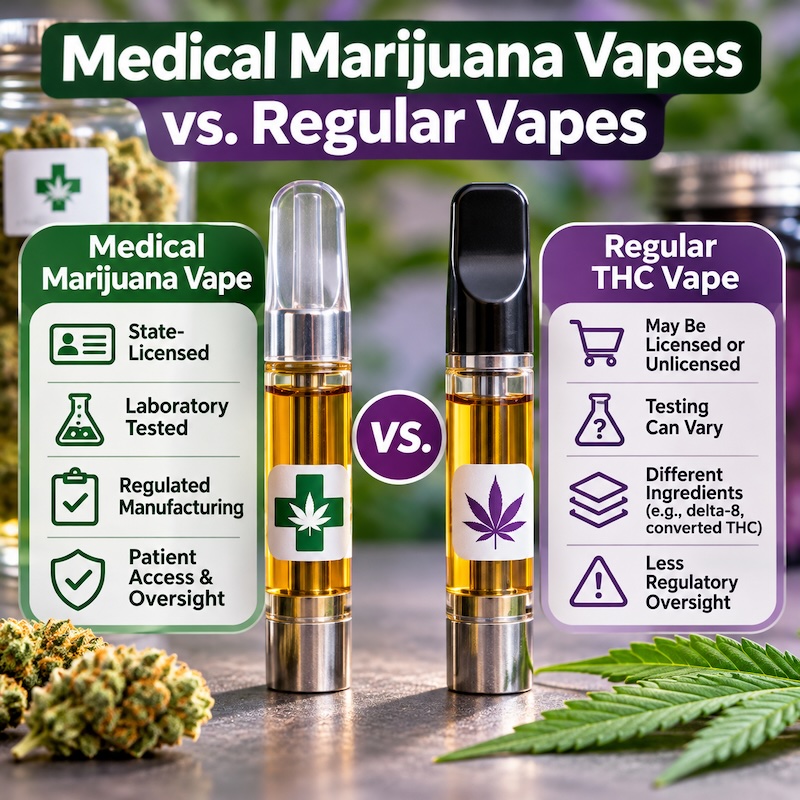

Medical Marijuana Vapes vs. Regular Vapes
If you’ve ever compared medical marijuana vapes with the THC vapes sold online or in ordinary vape shops, you’ve probably noticed that the products can look almost identical. Both might use a small 510-thread cartridge, both might contain cannabis-derived oil, and both might promise similar effects. So, what’s the actual difference?
In many cases, the biggest distinction isn’t the device or even the THC itself. It’s how the product is manufactured, tested, regulated, and sold.
A medical marijuana vape purchased from a state-licensed dispensary generally has to meet specific regulatory requirements. Those requirements can include laboratory testing for contaminants, accurate potency labeling, batch tracking, and restrictions on ingredients. Meanwhile, some THC vapes sold online or in convenience stores operate under completely different rules — and the amount of oversight can vary enormously.
There’s another important distinction, though. Medical marijuana vapes aren’t necessarily more strictly regulated than recreational cannabis vapes sold through licensed dispensaries. In some states, medical products have additional requirements. In others, medical and recreational products follow essentially the same testing standards.
I’ve been writing about vaping for more than 15 years, and I’ve seen enough questionable products to know that attractive packaging doesn’t tell you much about what’s inside. When it comes to cannabis vapes, understanding where a product comes from is particularly important.
Let’s look at how medical marijuana vapes compare with other THC products, what laboratory testing actually tells you, and what to consider before purchasing one.
Medical Marijuana Vapes vs. Regular THC Vapes: What’s the Difference?
First, let’s clarify what we’re comparing.
A medical marijuana vape is a cannabis vaping product sold through a state-regulated medical cannabis program. Depending on the state, purchasing one may require a medical marijuana card, patient registration, or authorization from a qualifying healthcare professional.
A regular THC vape could mean several different things. It might be a recreational cannabis vape sold through a licensed dispensary, a hemp-derived delta-8 product sold online, or an unlicensed THC cartridge from an ordinary smoke shop.
Those products don’t all belong in the same category.
Here’s how the differences typically break down.
| Feature | Licensed Medical Marijuana Vape | Licensed Recreational Cannabis Vape | Other THC Vape Sold Online or in Vape Shops |
|---|---|---|---|
| Regulatory oversight | State medical cannabis program | State adult-use cannabis program | Varies widely by state and product |
| Laboratory testing | State-mandated testing | State-mandated testing | May be mandatory, voluntary, or absent |
| THC potency labeling | Required under state rules | Required under state rules | Reliability varies |
| Contaminant screening | Required under applicable state standards | Required under applicable state standards | May be incomplete or unverified |
| Product tracking | Generally part of state-regulated supply chain | Generally part of state-regulated supply chain | Not necessarily required |
| Where it’s sold | Licensed medical dispensaries | Licensed adult-use dispensaries | Online retailers, smoke shops, and other outlets |
| Buyer requirements | Patient eligibility and state-specific rules | Generally 21 or older | Rules vary by jurisdiction |
The takeaway is that a licensed, regulated supply chain matters more than whether the package says “medical” or “recreational.”
A recreational cartridge from a licensed cannabis dispensary may be subject to substantially more oversight than a THC vape marketed as a medical or wellness product on an ordinary website.
What Is a Medical Marijuana Vape?
A medical marijuana vape is a vaporizing product intended for use within a state’s medical cannabis program.
The most common products use cannabis concentrates containing tetrahydrocannabinol (THC), cannabidiol (CBD), or a combination of cannabinoids.
THC is the primary intoxicating compound associated with marijuana. CBD isn’t intoxicating in the same way, although it can still have biological effects and interact with medications.
Medical cannabis vaping products commonly come in four formats:
- 510-thread cartridges: Prefilled oil cartridges that attach to a compatible rechargeable battery.
- Disposable cannabis vape pens: Devices containing both the battery and cannabis oil in one unit.
- Proprietary pod systems: Replaceable cannabis pods designed to work with a particular battery.
- Dry herb vaporizers: Reusable devices that heat cannabis flower instead of concentrated oil.
Medical dispensaries may offer products with different THC-to-CBD ratios, formulations, and cannabinoid profiles. Some patients prefer products containing more CBD or lower concentrations of THC, particularly when they want to minimize intoxication.
However, a state medical marijuana designation doesn’t mean that a specific product has been proven effective for a particular medical condition.
The FDA has not approved dispensary-sold cannabis vape cartridges as treatments for medical conditions. State medical cannabis authorization and FDA drug approval are two different things.
For patients who are considering medical marijuana vapes, it’s important to distinguish between a product that’s licensed for sale through a state medical cannabis program and one that’s been evaluated and approved as a prescription medication.
Why Are Medical Marijuana Vapes More Strictly Regulated?
One of the biggest advantages of purchasing cannabis through a licensed medical dispensary is that the product participates in an established regulatory system.
State programs typically impose requirements on manufacturers, laboratories, distributors, and dispensaries. Those requirements are intended to make products more consistent, improve accountability, and reduce the likelihood of contaminated products reaching consumers.
The exact standards vary by state, but several important safeguards are common.
1. Medical Cannabis Products Undergo Laboratory Testing
Licensed cannabis products generally have to pass laboratory testing before being sold.
Depending on the state and product type, this testing can include:
- Cannabinoid potency: Measuring THC, CBD, and other cannabinoids to verify the product’s strength.
- Pesticide residues: Checking for potentially harmful agricultural chemicals.
- Heavy metals: Screening for contaminants such as lead, arsenic, cadmium, and mercury.
- Residual solvents: Checking for solvents left behind during extraction or processing.
- Microbial contamination: Testing for potentially harmful microorganisms.
- Mycotoxins: Screening for toxic substances produced by certain molds.
For cannabis vape cartridges, testing is particularly important because you’re inhaling an aerosol produced from a concentrated extract.
Some contaminants that might be present in raw cannabis can become concentrated during extraction.
Testing can’t guarantee that inhaling a product is harmless, but it can identify specific hazards that might otherwise go undetected.
2. Some States Require Additional Medical Testing
Medical and recreational cannabis products don’t always follow identical standards.
For example, Washington State has additional requirements for products designated as medically compliant. These include stricter pesticide requirements and additional testing for contaminants such as heavy metals.
Other states use largely the same testing system for medical and recreational products.
California, for instance, requires licensed cannabis products to undergo comprehensive testing regardless of whether they’re intended for medical or adult use.
That means you shouldn’t assume every medical marijuana product has received more extensive testing than every recreational product.
The important question is which requirements apply to the particular product in the particular state where it’s sold.
3. Products Are Tracked Through the Supply Chain
Licensed cannabis programs generally use tracking systems that follow products from cultivation and manufacturing through distribution and retail sales.
These systems are often described as seed-to-sale tracking.
Tracking helps regulators identify where a product originated, which business manufactured it, and where individual batches were distributed.
If a laboratory discovers contamination or regulators identify a manufacturing problem, this information can help them trace affected inventory and organize recalls.
An unlicensed cartridge purchased through an ordinary online retailer may have no comparable tracking system.
If something goes wrong, identifying its actual manufacturer can be difficult — particularly if the packaging uses an unverified brand name.
4. Manufacturers and Dispensaries Must Hold Appropriate Licenses
Licensed medical marijuana businesses operate under state rules covering their facilities, personnel, manufacturing practices, storage, and sales.
Regulators may inspect facilities, investigate complaints, suspend licenses, or require products to be removed from sale.
Not every violation is caught, and the existence of a license doesn’t guarantee perfect compliance.
However, there’s a meaningful difference between a business that’s accountable to a cannabis regulator and an anonymous supplier that can disappear when complaints start arriving.
What About THC Vapes Sold Online or in Ordinary Vape Shops?
This is where things get complicated.
The United States has multiple overlapping markets for cannabis-derived products, and the term “THC vape” doesn’t necessarily tell you which one you’re looking at.
Some products come from fully licensed cannabis manufacturers. Others are sold as hemp-derived cannabinoid products, while some may come from unlicensed or illicit suppliers.
Hemp-Derived THC Vapes
You may have seen vape cartridges advertised as containing delta-8 THC, delta-10 THC, THCA, or other hemp-derived cannabinoids.
These products became widely available following the 2018 Farm Bill, which established a federal distinction between hemp and marijuana based on delta-9 THC concentration.
Some businesses used that distinction to market intoxicating products derived from hemp, including vapes containing delta-8 THC.
Delta-8 occurs naturally in cannabis in small amounts, but commercial quantities are typically produced by chemically converting hemp-derived CBD.
That additional processing introduces potential concerns.
If a manufacturer doesn’t adequately purify and test the finished material, the oil may contain residual chemicals or unwanted reaction byproducts.
The FDA has specifically raised concerns about delta-8 THC manufacturing methods, inconsistent labeling, and reports of adverse reactions.
Another complication is that individual states have taken very different approaches to these products.
Some prohibit particular intoxicating hemp cannabinoids. Others regulate them through cannabis or hemp licensing systems, with mandatory testing and age restrictions.
Federal hemp laws are also changing in late 2026, adding further uncertainty for products containing intoxicating cannabinoids.
A THC vape being sold openly online or at a convenience store doesn’t necessarily mean it’s legal in your state, properly tested, or produced by a licensed cannabis manufacturer.
Are All Online THC Vapes Unregulated?
No, and this is an important distinction.
Some state-licensed cannabis dispensaries allow customers to browse products online and arrange in-store pickup or legally permitted local delivery.
Those products remain part of the state’s regulated cannabis supply chain.
That’s very different from a general e-commerce website offering to mail THC cartridges across the country without demonstrating that it holds the required licenses.
Some states also regulate hemp-derived cannabinoid manufacturers and retailers, requiring laboratory testing and other consumer protections.
So, the presence of an online ordering system doesn’t automatically tell you whether a product is regulated.
What matters is the seller’s licensing status, the product’s origin, and the rules governing its sale.
What’s Actually Inside a THC Vape Cartridge?
Two THC cartridges may look similar from the outside while containing very different substances.
Understanding the terminology on the label can help explain the differences.
Cannabis Distillate
Distillate is a highly refined cannabis extract containing a concentrated amount of a particular cannabinoid, usually THC.
Much of the plant’s original flavor and aroma is removed during processing, so manufacturers may add terpenes to produce a more recognizable cannabis flavor or a particular flavor profile.
Distillate is common in both medical and recreational dispensary cartridges.
Its high THC concentration can also make it surprisingly potent for inexperienced users.
Live Resin
Live resin is generally produced using cannabis that has been frozen soon after harvesting.
The extraction process is intended to preserve more of the plant’s original aromatic compounds.
Live resin products often contain a wider range of terpenes than highly refined distillates, although their composition depends on the extraction process.
The term describes how the extract is produced. It doesn’t automatically guarantee better safety, greater effectiveness, or more extensive testing.
Rosin
Rosin is a cannabis concentrate produced using heat and pressure rather than the conventional hydrocarbon solvents used for many other extracts.
Live rosin is often made from fresh-frozen cannabis that has first been processed into hash.
Because rosin production doesn’t require those extraction solvents, it avoids one potential source of residual solvent contamination.
However, rosin can still contain pesticides, heavy metals, or other contaminants present in the original material.
Solventless doesn’t mean contaminant-free.
Delta-8 and Other Converted Cannabinoid Oils
Many hemp-derived THC products contain cannabinoids that have been chemically converted from CBD.
The manufacturing process can create additional compounds that require proper identification and removal.
A laboratory report that only measures THC potency doesn’t establish that the finished oil is free from potentially harmful processing byproducts.
This is one reason comprehensive contaminant testing matters.
How Do You Know Whether a THC Vape Has Been Properly Tested?
One of the most useful things to look for is a Certificate of Analysis (COA).
A COA is a laboratory report documenting the testing performed on a particular product sample or production batch.
Licensed cannabis manufacturers generally have to obtain compliant laboratory results before selling regulated products.
Some packages include a QR code that makes the report accessible, while dispensaries may provide testing information on request.
However, a QR code isn’t mandatory in every jurisdiction, and its absence doesn’t automatically mean a product is untested.
Here’s what I’d check when evaluating a COA.
Does the Batch Number Match?
The laboratory report should identify the tested batch or lot.
That identifier should correspond with the product’s packaging or other traceability information.
A report for a different batch isn’t proof that the cartridge you’re holding passed testing.
Was the Testing Performed by an Appropriate Laboratory?
For state-regulated products, the laboratory should meet the state’s licensing and accreditation requirements.
An independent testing laboratory is generally more credible than a manufacturer simply claiming that it tested its own product.
For online THC products, verify the laboratory’s identity and whether the report can be authenticated.
Does the Report Include Contaminant Testing?
Some online sellers advertise products as “lab tested” but only provide a report showing THC potency.
That’s better than having no information about the cannabinoid content, but it doesn’t answer the most important safety questions.
Look for the contaminant testing applicable to the product, especially pesticides, heavy metals, and residual solvents.
For converted cannabinoids, appropriate screening for manufacturing byproducts is also important.
Is the Report Current and Relevant?
A test result from an old product batch doesn’t necessarily tell you anything about a new batch manufactured months later.
Reports should correspond to the actual product being sold.
And remember that even a legitimate COA has limitations. Testing typically examines samples of a production batch, not every individual cartridge.
It may not fully characterize the aerosol that a device produces during heating, either.
A passing test result reduces uncertainty. It doesn’t eliminate every possible risk.
Are Medical Marijuana Vapes Safer Than Regular THC Vapes?
A properly regulated medical marijuana vape offers more meaningful quality controls than an unlicensed, untested THC cartridge.
That’s the clearest practical distinction.
State-mandated testing can reduce the likelihood of exposure to certain contaminants, while licensing and product tracking make manufacturers more accountable.
But that doesn’t mean medical marijuana vaping is completely safe.
Inhaling cannabis aerosol can irritate the respiratory system, and research into the long-term effects of cannabis vaping is still developing.
High-THC products can also cause unwanted effects such as anxiety, dizziness, impaired coordination, and increased heart rate. Frequent cannabis use can lead to dependence, and high-potency products may increase certain risks.
The concentration of THC in a medical cartridge isn’t necessarily lower than the concentration in a recreational cartridge.
What the 2019–2020 Vaping Lung Injury Outbreak Taught Us
The outbreak of e-cigarette or vaping product use-associated lung injury (EVALI) in 2019 and 2020 demonstrated how dangerous contaminated THC cartridges can be.
Investigators linked many cases to THC-containing vaping products obtained through informal sources.
Vitamin E acetate, which had been used as an additive in some THC cartridges, was strongly associated with the outbreak.
Vitamin E acetate shouldn’t be used as an ingredient in inhaled cannabis oils.
The outbreak provided an important lesson about the risks of poorly controlled manufacturing and undisclosed ingredients.
It did not establish that all THC vaping is equally dangerous, nor did it prove that products from licensed dispensaries are risk-free.
The CDC and FDA have advised against using THC vaping products because of potential health risks, particularly products obtained from informal or unregulated sources.
If someone is using medical cannabis for a health condition, the potential benefits and risks should be discussed with a qualified healthcare professional. Non-inhaled formulations may be more appropriate for some patients.
Do Medical Marijuana Vapes Work Differently From Recreational THC Vapes?
Not necessarily.
The way a cannabis vape affects someone depends on several factors, including:
- The amount of THC and CBD it contains.
- The quantity inhaled.
- Other cannabinoids and compounds in the extract.
- Individual sensitivity and previous cannabis exposure.
- The device’s operating temperature and vapor production.
A medical cartridge and a recreational cartridge containing comparable formulations could produce similar effects.
The word “medical” doesn’t change the chemistry of THC.
Where medical cannabis programs can differ is in the selection of available products and the guidance associated with their use.
Some dispensaries offer balanced THC-to-CBD formulations or products intended for patients who want to avoid very high THC concentrations.
Patients may also have access to clinicians who can discuss potential interactions with other medications, contraindications, and alternatives.
That kind of guidance is particularly valuable because medical cannabis products aren’t standardized like conventional FDA-approved prescription medications.
How Quickly Do Cannabis Vapes Work?
Inhaled cannabinoids generally begin producing noticeable effects within minutes.
Effects may continue developing after the first few inhalations, and impairment can last for several hours.
This rapid onset is one reason inhaled cannabis differs from edible products, which usually take longer to produce noticeable effects.
However, rapid onset can also make high-potency products easy to overuse.
Someone who is unfamiliar with THC may experience unpleasant effects from an amount that a more experienced user tolerates.
For patients, a clinician’s guidance on formulation and dosing is more useful than relying on a cartridge’s advertised potency or another person’s experience.
Are Medical Marijuana Vape Batteries Different?
Usually, no.
Medical cannabis cartridges often use the same general battery technology found in recreational cannabis vaping devices.
The most common format is the 510-thread battery, which has a standardized threaded connection compatible with many cannabis cartridges.
You’ll also encounter proprietary pod batteries and disposable pens.
A battery isn’t automatically medical-grade simply because it’s sold through a dispensary.
The more important considerations are whether the hardware is compatible with the cartridge, whether it operates within the manufacturer’s recommended voltage range, and whether it has appropriate electrical safety features.
Some batteries offer adjustable voltage settings, allowing them to be used with different cartridge types.
If you’re unfamiliar with these devices, my guide to 510 battery charging covers charging times, charging precautions, and the factors that affect battery performance.
One other thing worth remembering is that a cannabis oil cartridge shouldn’t be treated like an ordinary nicotine e-liquid tank.
Cannabis concentrates and nicotine e-liquids have different formulations, and devices aren’t necessarily interchangeable.
Don’t attempt to put cannabis concentrates into a nicotine vape unless the manufacturer explicitly designed the device for that purpose.
Likewise, don’t modify sealed cartridges or add substances to cannabis oils.
Why Do Some Cannabis Vapes Make You Cough?
Cannabis vaping can irritate the throat and lungs, particularly with concentrated extracts or high operating temperatures.
Several factors may contribute to coughing:
- Hot, dense aerosol.
- Irritating compounds in the extract.
- Long or forceful inhalations.
- Individual respiratory sensitivity.
- A device that’s overheating the oil.
A harsh sensation doesn’t necessarily mean the cartridge is contaminated, but it also shouldn’t be dismissed as something a person simply has to tolerate.
Some of the general principles covered in my guide to using a vape without coughing apply to cannabis devices, including understanding how inhalation technique and vapor temperature affect throat irritation.
However, persistent coughing, chest discomfort, wheezing, or breathing difficulty should never be treated as ordinary side effects to push through.
Stop using the product and seek appropriate medical evaluation, particularly if symptoms are severe or worsening.
Are Medical Marijuana Vapes Legal Throughout the United States?
No. Medical marijuana laws still vary significantly from state to state.
You can find a general overview of U.S. medical cannabis programs, but you’ll need to consult your own state’s cannabis regulator for current eligibility, purchasing, possession, and transportation rules.
Some states allow registered medical cannabis patients to purchase products that recreational customers cannot buy.
Others have legalized both medical and recreational cannabis, while some maintain restrictions that limit access to certain qualifying patients.
Medical marijuana cards also aren’t universally recognized across state lines.
A medical authorization issued in one state doesn’t automatically give you permission to purchase or possess cannabis in another.
Does Federal Rescheduling Mean Medical Cannabis Vapes Are FDA-Approved?
No.
In April 2026, the federal government issued a rule placing marijuana products covered by qualifying state medical marijuana licenses into Schedule III of the Controlled Substances Act.
That action was separate from the broader process of rescheduling marijuana generally.
It did not mean that every dispensary cartridge had undergone FDA drug approval or that interstate cannabis sales and transportation became unrestricted.
These are separate legal and regulatory questions.
For consumers, the practical advice is straightforward: follow the rules of the state where you’re located, purchase only through appropriately licensed channels, and don’t assume that a medical marijuana card permits travel with cannabis across state lines or through airports.
Do Medical Marijuana Vapes Cost More?
They can, although medical products aren’t automatically more expensive than recreational cannabis vapes.
The price depends on the state, the manufacturer, the type of extract, the quantity of oil, and the applicable taxes.
Licensed cannabis manufacturers have expenses associated with testing, compliance, packaging, security, licensing, and tracking. Those costs can influence retail prices.
However, medical cannabis patients may receive tax advantages that recreational customers don’t.
Some states impose lower taxes on medical cannabis purchases, and certain programs offer other patient benefits.
As a result, the same or similar cartridge might cost less to a registered medical patient than to a recreational customer.
An unlicensed THC cartridge might appear cheaper initially because its manufacturer hasn’t incurred comparable compliance expenses.
But a lower price isn’t particularly meaningful if you can’t verify what the product contains.
I’d rather know that a product’s manufacturer is licensed and its batch has passed the applicable tests than save a few dollars on a cartridge with no reliable manufacturing history.
How to Identify a Trustworthy Cannabis Vape
If you’re evaluating cannabis products for medical use, I think a few checks matter much more than flashy packaging, exaggerated potency claims, or impressive-sounding strain names.
1. Verify the dispensary’s license. Make sure the business is authorized to sell cannabis products under the relevant state program. A professional-looking website doesn’t establish licensing.
2. Check the product’s manufacturer. A recognizable brand name isn’t enough on its own. Look for a manufacturer operating within the licensed cannabis system.
3. Review the testing information. Confirm that the product has passed the testing required by the state and that any available COA corresponds to the correct batch.
4. Read the cannabinoid information. Understand the THC and CBD concentrations rather than assuming a medical product will be mild.
5. Look for unexplained additives. Be cautious of cartridges with unclear ingredient lists, undisclosed thinning agents, or vague claims about proprietary formulations.
6. Check the packaging. Licensed products should have the labeling, warnings, batch information, and other identification required in their jurisdiction.
7. Consider the hardware. Damaged cartridges, leaking oil, counterfeit-looking packaging, and unexplained hardware defects are all reasons to avoid a product.
None of these checks guarantees safety, but together they provide a much stronger basis for evaluating a product than its appearance or marketing claims.
Frequently Asked Questions
Is a Medical Marijuana Vape the Same as a THC Vape?
A medical marijuana vape is a type of THC or cannabis vape sold through a regulated medical cannabis program.
Other THC vapes may be sold through licensed recreational dispensaries or through separate hemp-derived cannabinoid markets.
The differences often involve licensing, testing, ingredients, patient eligibility, and legal requirements rather than the vaping hardware itself.
Are Medical Marijuana Vapes Stronger Than Regular Vapes?
Not necessarily.
Medical and recreational cannabis cartridges can contain similar concentrations of THC.
Some medical products contain balanced THC-to-CBD formulations or lower THC concentrations, while others contain highly concentrated extracts.
Always check the actual cannabinoid content rather than relying on the medical or recreational label.
Are Medical Marijuana Vapes Tested for Pesticides?
Yes, licensed medical cannabis programs generally require testing for pesticides and other contaminants, although the exact standards vary by state and product type.
Some states impose additional testing or stricter limits for certain medical cannabis categories.
Passing these tests doesn’t mean a product has been proven completely safe to inhale.
Are Delta-8 Vapes the Same as Medical Marijuana Vapes?
No.
Delta-8 THC is a psychoactive cannabinoid commonly produced through chemical conversion of hemp-derived CBD.
Many delta-8 products have been marketed outside state medical cannabis systems, although some jurisdictions regulate hemp-derived cannabinoids through licensing and testing programs.
Delta-8 products aren’t FDA-approved medical marijuana treatments, and their legal status and testing requirements vary.
Can I Buy Medical Marijuana Vapes Online?
Some licensed dispensaries allow online ordering for pickup or legally permitted delivery within their state.
That isn’t the same as an ordinary online retailer shipping THC cartridges nationwide.
Medical cannabis purchases remain subject to applicable federal and state restrictions, and a medical marijuana card doesn’t automatically authorize interstate shipments.
Are Medical Marijuana Vapes FDA-Approved?
No. Cannabis vape cartridges sold through state medical marijuana dispensaries aren’t FDA-approved treatments.
Some cannabinoid-based prescription medications have received FDA approval, but those are different products.
State authorization permits qualifying cannabis products to be sold under a particular regulatory program; it doesn’t establish that the FDA has approved them for treating a disease.
Is a Medical Marijuana Vape Safer Than a Recreational Cannabis Vape?
Not automatically.
Both medical and recreational products sold through licensed dispensaries can be subject to extensive testing and tracking requirements.
Some states apply additional standards to medical products, but that isn’t universal.
A more important distinction is between regulated, tested cannabis products and unlicensed or unverified products.
Neither category of cannabis vape is risk-free.
Can You Use an Ordinary Vape Battery With a Medical Marijuana Cartridge?
Many medical cannabis cartridges use the standard 510-thread connection and can work with compatible 510-thread batteries.
However, some products require proprietary batteries, and compatibility involves more than the threaded connection alone.
Always follow the cartridge and battery manufacturers’ recommendations.
Final Thoughts: Are Medical Marijuana Vapes Better Than Regular THC Vapes?
The biggest advantage of a licensed medical marijuana vape isn’t that it necessarily contains better cannabis or produces different effects. It’s the regulatory system behind the product.
Licensed medical cannabis programs typically require product testing, manufacturing controls, batch tracking, and accountable retailers. Some states go further and impose additional standards on medical products.
Those safeguards make a meaningful difference when compared with THC cartridges that have little verified information about their ingredients or origin.
However, licensed recreational cannabis products can offer many of the same protections. A medical label, by itself, isn’t proof of superior quality.
That’s why I wouldn’t automatically trust a vape because it’s advertised as medical, hemp-derived, premium, or laboratory-tested.
I’d want to know who manufactured it, whether the seller is licensed, what testing the particular batch received, and whether those results can be verified.
The 2019–2020 lung injury outbreak made it painfully clear why those questions matter. When you’re inhaling something directly into your lungs, a mystery ingredient is a rather significant drawback.
Ultimately, a properly licensed and tested cannabis product provides more transparency and accountability than an unverified alternative. That doesn’t make cannabis vaping harmless or guarantee that it will help with a medical condition, but it does give patients and consumers better information about what they’re purchasing.
For anyone considering cannabis as part of a medical treatment plan, the most important step is to discuss the potential risks, benefits, and alternatives with a qualified healthcare professional.
This article is intended for informational purposes and isn’t medical or legal advice. Cannabis can cause impairment, dependence, and other adverse effects. Cannabis vaping carries respiratory risks, and people who are pregnant, younger than the legal age, or managing certain health conditions should avoid cannabis use or seek individualized medical guidance. Never drive while impaired.

0 Comments