

If you’ve spent any time shopping for vape juice, you’ve probably seen bottles labeled with things like 50/50, 70/30, or 80/20 and wondered whether you were buying e-liquid or trying to decode a math problem.
Those numbers refer to the PG/VG ratio of the e-liquid. PG and VG are the two base ingredients that make up most vape juice, and they have a big effect on how the liquid feels, tastes, and performs in different devices. Most e-liquids use a blend of both because each ingredient brings something useful to the table.
So, what are PG and VG, and why do they matter?
Recent Price Drop
The Geek Bar Pulse is just $16.99 after a recent price drop! Take an additional 20% off with the coupon code VAPEGRL. Shop Now.
What Is PG?

PG stands for propylene glycol.
In vape juice, PG is the thinner of the two main base ingredients. It’s especially good at carrying flavor, and it also tends to create a stronger throat hit. That makes PG-heavy e-liquids feel a little sharper and more cigarette-like to some people. Because PG is thinner, it also tends to wick more easily in smaller or lower-powered devices.
In plain English, PG is the part that usually helps make flavor feel clearer and the inhale feel a little more noticeable.
What Is VG?
VG stands for vegetable glycerin.
VG is thicker than PG, slightly sweet, and better known for producing denser vapor. E-liquids with more VG usually feel smoother on the throat and are often preferred by people who want a softer inhale or bigger clouds. The tradeoff is that VG can mute flavor a bit compared to PG, and because it’s thicker, it can be harder for some smaller devices to wick efficiently.
So if PG is the flavor-forward, throat-hit side of vape juice, VG is the smoother, cloudier side.
Why Do Vape Juices Use Both?
Because most people want some combination of:
- good flavor
- decent vapor production
- a comfortable inhale
- a liquid that works properly in their device
That’s why most e-liquids are blends rather than all-PG or all-VG. Using both ingredients lets manufacturers balance flavor, throat hit, vapor, and wicking performance instead of pushing everything hard in one direction.
What Does a PG/VG Ratio Mean?
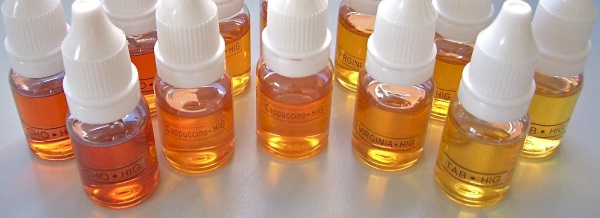
A PG/VG ratio tells you how much of each ingredient is in the e-liquid.
For example:
- 50/50 means the liquid contains roughly equal parts PG and VG
- 70/30 VG/PG means it’s mostly VG
- 70/30 PG/VG means it’s mostly PG
Manufacturers don’t always write the ratio in the same order, which is part of the fun, if your idea of fun is avoidable confusion. Some labels list VG/PG, and others list PG/VG, so it’s worth checking which way the bottle is presenting it.
What Is High-PG Vape Juice Like?
A higher-PG e-liquid usually gives you:
- a stronger throat hit
- clearer or more pronounced flavor
- less visible vapor
- a thinner liquid that wicks easily
That’s one reason high-PG liquids used to be especially popular with people who wanted a more cigarette-like feel. They tend to feel a little punchier on the inhale and often work well in smaller devices that don’t handle thick liquid as gracefully.
What Is High-VG Vape Juice Like?
A higher-VG e-liquid usually gives you:
- smoother inhales
- thicker vapor
- a slightly sweeter overall feel
- a thicker liquid consistency
That thicker consistency can be great in devices designed for it, but it can also be a problem in smaller or lower-powered devices if the liquid is too thick to wick properly. High-VG liquids are usually chosen by people who care more about smoothness and vapor production than about maximizing throat hit.
Which Is Better for Flavor?
In general, PG carries flavor better than VG.
That doesn’t mean every high-PG e-liquid will automatically taste better than every high-VG one, because flavor quality also depends on the recipe itself. But as a rule, PG tends to deliver flavor more sharply, while VG tends to soften things a bit and add some sweetness of its own.
So if a liquid tastes a little muted, the VG content may be part of the reason.
Which One Makes Bigger Clouds?
That would be VG.
If you want thicker, denser vapor, higher-VG e-liquid is usually the way to go. VG is the ingredient most associated with cloud production, which is why VG-heavy blends became so common in more vapor-focused parts of the market.
Which One Feels Harsher?
Usually PG.
PG tends to produce more throat hit, which some people like and some people do not. VG is generally smoother. So if a vape feels too sharp or irritating, switching to a higher-VG liquid may help.
Of course, nicotine strength also plays a big role here, so PG and VG are not the only reason a vape feels harsh. But they are definitely part of the equation.
Can Some People Be Sensitive to PG?
Yes.
Some people find that high-PG e-liquids irritate their throat, make their mouth feel dry, or just don’t agree with them very well. The article also notes that some users report symptoms such as throat irritation, dryness, headaches, nausea, skin reactions, or sinus issues when they’re sensitive to PG.
That does not mean everyone is allergic to PG, and it certainly doesn’t mean every sore throat after vaping is caused by PG. But if a liquid consistently feels irritating, trying a higher-VG blend is a reasonable thing to do.
What Ratio Should You Choose?
That depends on what kind of experience you want and what kind of device you’re using.
50/50
A 50/50 e-liquid is often a good middle ground. It offers a balance of flavor, throat hit, vapor production, and wicking performance.
Higher PG
A higher-PG liquid may suit you better if you want a stronger throat hit, clearer flavor, and a thinner liquid.
Higher VG
A higher-VG liquid may be the better choice if you want smoother inhales, more vapor, and a softer overall feel.
In other words, the “best” ratio is not universal. It depends on what you want your vape to feel like.
Do PG and VG Affect Device Performance?
Yes, very much.
Because PG is thinner, it tends to wick more easily. Because VG is thicker, it can be more demanding. If you use a very thick e-liquid in a device that prefers thinner liquid, you may run into issues like poor wicking, weak performance, or burnt hits. On the other hand, a liquid that’s too thin for a given setup may not give the kind of experience you want either.
This is one reason the PG/VG ratio matters more than people sometimes expect. It’s not just a label. It changes how the liquid behaves.
Final Thoughts
PG and VG are the two main base ingredients in vape juice, and they shape almost everything about how an e-liquid feels. PG is thinner, carries flavor well, and usually gives more throat hit. VG is thicker, smoother, and better for denser vapor. Most e-liquids use both because the goal is usually balance rather than extremes.
So if you’ve ever wondered why one vape juice feels sharper, another feels smoother, and a third seems to produce enough vapor to announce itself to neighboring counties, the PG/VG ratio is a big part of the answer.

Great information.